Multi-Agent architecture enables the effective implementation of BIAN (Banking Industry Architecture Network) principles by introducing an intelligent layer that orchestrates the bank’s Service Domains. In this approach, artificial intelligence agents interpret requests from customers or employees, identify intent, and coordinate interactions with multiple banking capabilities exposed through APIs, while keeping the experience, business, and data layers defined by BIAN decoupled.
BIAN defines banking architecture through Service Domains, each responsible for a specific business capability.
Examples include:
- Customer Management
- Contact Dialogue
- Product Management
- Customer Offer
- Payment Execution
- Document Management
By integrating technologies such as AWS Bedrock, Amazon Connect, and advanced language models like Claude, agents can operate within the Experience Layer, managing conversational interactions and automating service processes, while the BIAN Service Domains continue executing the core banking logic.
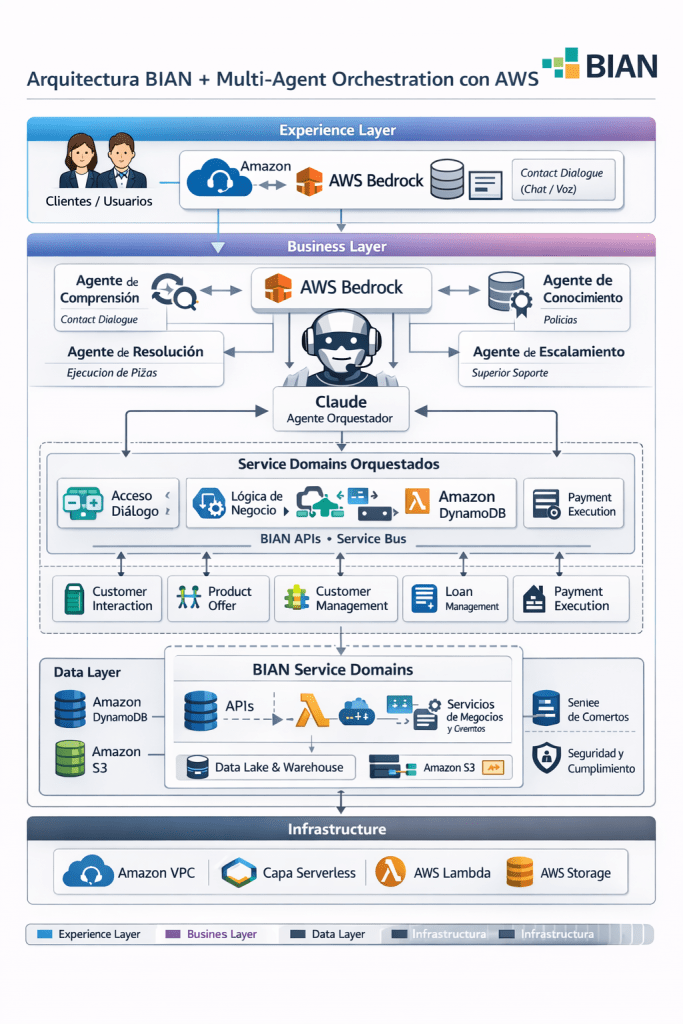
This model also enables the real implementation of Composable Banking, where banking capabilities are built as independent services that can be dynamically combined to support different customer journeys. Agents act as an orchestration layer that selects and coordinates the required services—such as Customer Management, Product Offer, Loan Management, or Payment Execution—to efficiently resolve a request.
In this way, financial institutions can evolve toward more modular, scalable, and service-oriented platforms, reducing integration complexity between systems and improving their ability to adapt to new business and customer needs.
Within a multi-agent architecture, each agent can act as an orchestrator or consumer of these Service Domains and collaborate in the automation of a Composable Banking Architecture.
Use Cases
- Experience Layer on top of BIAN Architecture
BIAN clearly separates:
- Experience Layer
- Business Layer
- Data Layer
AI agents are primarily positioned within the Experience Layer.
Simplified architecture:
Agents become an intelligent interaction and orchestration layer.

2. Real Implementation of Composable Banking
BIAN promotes the concept of Composable Banking Architecture, where:
- Banking capabilities are delivered as services
- Services can be dynamically combined
Autonomous agents act as a dynamic composition layer.
Example
Complex request:
“I want to increase my credit card limit and check my available balance.”
The system could coordinate:
- Card Management
- Customer Profile
- Risk Assessment
- Customer Offer
Agents:
- decide which services to use
- coordinate execution
- aggregate the results
This reduces the need for rigid orchestration within traditional middleware.
- Enhancing the BIAN Customer Journey Model
BIAN aims to support end-to-end Customer Journeys.
Agents help to:
- interpret intent
- navigate complex processes
- automate steps
- maintain context
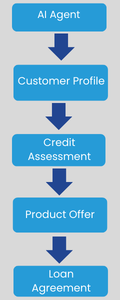
Example journey
Customer requests a loan
The agent coordinates multiple Service Domains.
4. Reducing Integration Complexity
BIAN architectures typically include:
- many microservices
- APIs
- event-driven components
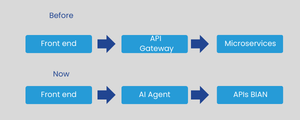
Agents can act as an intelligent semantic layer.
Benefits include:
- simplified integration
- reduced coupling
- conversational interfaces on top of APIs
5. Automation of Internal Support (BIAN Internal Operations)
Agents can also support internal processes.
Examples include:
- employee support
- policy and procedure inquiries
- back-office operations
By consulting BIAN domains such as:
- Document Management
- Operational Services
- Customer Support Services
6. Autonomous Agents as a Dynamic Composition Layer
Complex request:
“I want to increase my credit card limit and check my available balance.”
The system could coordinate:
- Card Management
- Customer Profile
- Risk Assessment
- Customer Offer
Agents:
- decide which services to use
- coordinate execution
- aggregate results
This significantly reduces the need for rigid orchestration in traditional middleware.
How Do We Ensure Multi-Agent Orchestration Works Effectively?
The next step in enterprise automation—and one of the most significant advances in AI applied to business—is Multi-Agent Orchestration.
Instead of relying on a single virtual assistant, organizations can deploy ecosystems of specialized agents that collaborate with each other to solve tasks in a coordinated manner.
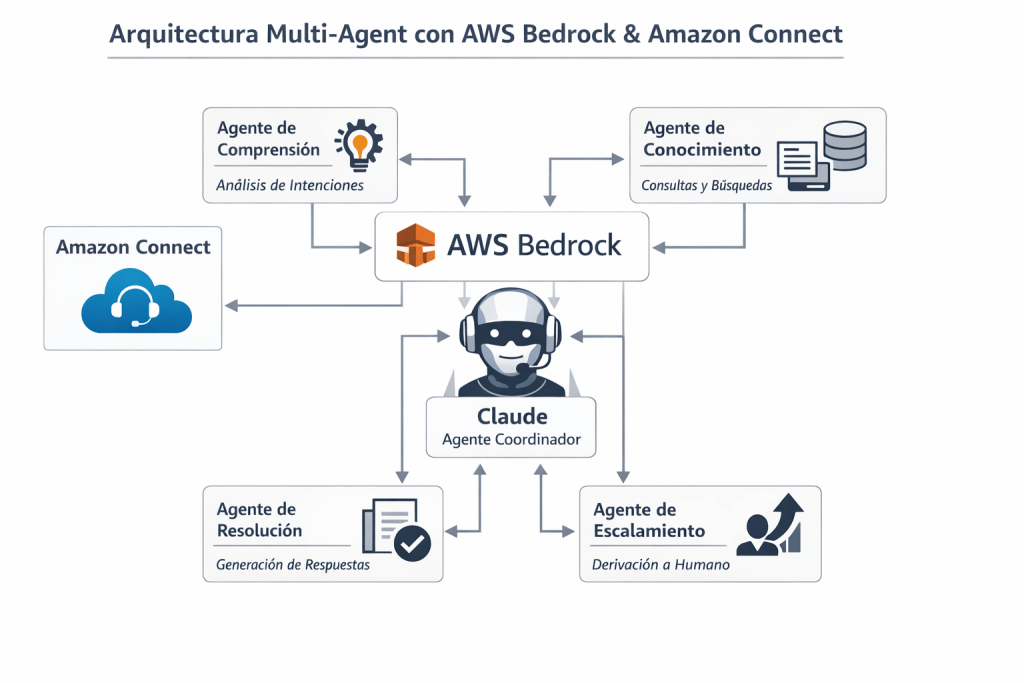
In this model, each agent performs a specific role within a process. For example:
- one agent interprets the user request
- another consults knowledge bases or enterprise systems
- another generates the final response or executes an action within the organization’s systems
Orchestration allows these agents to function as a digital team, exchanging information and delegating tasks according to the complexity of the request. This enables the automation of processes that previously required multiple systems and the involvement of several human teams.
In customer service or internal support scenarios, this architecture can create flows such as:
- An interaction agent receives the request through chat or voice.
- A comprehension agent interprets the user’s intent.
- A knowledge agent consults documentation, FAQs, or enterprise databases.
- A resolution agent generates the response or executes the required action.
- If necessary, an escalation agent transfers the case to a human specialist.
This architecture not only improves automation capabilities, but also enables the creation of systems that are more flexible, scalable, and adaptable, allowing organizations to monetize the usage and consumption of each agent per business unit based on demand.
Agent orchestration therefore represents a fundamental shift in how companies design digital platforms, moving from monolithic applications to intelligent ecosystems of collaborative agents.
The Future of Enterprise Support with AI Agents
Autonomous agents are not intended to replace human teams, but rather to augment their capabilities, enabling organizations to build more agile, intelligent, and scalable service platforms.
With technologies such as Amazon Bedrock, Amazon Connect, and advanced models like Claude, it is now possible to design service platforms that combine automation, artificial intelligence, and human expertise, marking the beginning of a new generation of digital services.
At Arkkosoft, we continue exploring these technologies to help organizations modernize their service and support processes, bringing artificial intelligence into real business use cases.
Call us and we will guide you on how to advance your Artificial Intelligence strategy.