By Allan Pérez
What started as a curiosity has become a teammate. Here is what has changed, how AI helps us standardize processes and support developers, and where we want to go next.
At a Glance • AI is now part of everyday work across nearly every profession. • In administration and project management, it cuts time spent on repetitive tasks and helps standardize processes. • Our goal: people and AI working together, with clear rules and a human always accountable. |
Just three years ago, talking about artificial intelligence in the office sounded like science fiction—or a fun experiment with a chatbot. Today, it is part of everyday work: drafting an email, summarizing a meeting you could not take notes on, organizing the backlog, and preparing Friday’s status report.
What matters most is not simply that AI “does things,” but how it is changing the way we work together: less time spent on repetitive tasks and more time to think, make decisions, and talk.
How we got here
Un cambio que toca todas las profesiones
Four stages in the evolution of AI at work.
2023 | Curiosity. We tried chatbots for writing, translation, and questions. Individual, experimental use. |
2024 | The copilot. AI becomes part of email, documents, spreadsheets, and code editors. |
2025 | The first agents. Pilots that carry out multiple steps: scheduling, categorizing, creating tasks, and generating reports. |
2026 | Today: AI in the workflow. Connected to team tools, with clear rules and human approval. In June, PMI published a standard on AI in projects. |
A shift affecting every profession
This is not just about technology. In human resources, 87% of companies already use AI for at least one function (SHRM, 2026). In the legal sector, nearly eight in ten surveyed firms have adopted it (Clio). And in finance, invoice automation is reducing processing times from days to hours.
- Human resources: candidate screening, interview scheduling, and answering common questions.
- Finance: reconciliations, invoice processing, and period-end reporting.
- Legal: contract review and legal research.
- Software development: coding, debugging, testing, and documentation.
Administrative work: less copying and pasting, more judgment
If you work in administration or project management, you know the routine: meeting, notes, summary, email, board updates—and repeat. According to figures cited by Forbes, 45% of project managers spend more than one day a week manually reporting progress. AI does not eliminate this work; it compresses it.
Before · About 3 hours 1. Meeting 2. Handwritten notes 3. Write the summary 4. Create tasks one by one 5. Follow-up email 6. Update the report | Now · About 30 minutes 1. Meeting 2. AI transcribes, summarizes, and suggests tasks 3. You review and refine 4. Tasks, email, and report are published in a consistent format |
Times are illustrative; actual savings depend on the team and how well its information is organized.
Project Management: AI drafts, you make the calls
In 2026, project management has changed on three fronts: administrative tasks are completed faster and in a consistent format; we can search across project knowledge as though asking a colleague; and tools can suggest plans and updates, or even take action with approval.
What has not changed: setting priorities, negotiating with stakeholders, and taking responsibility remain human responsibilities.
Stage | How AI Helps | You Decide |
Initiation | Draft charter, stakeholders, milestones | Why the project exists and what success looks like |
Planning | Work breakdown structure, dependencies, backlog, and sprints | Sequence, resources, and priorities |
Execution | Meeting notes, action items, and alerts | How to resolve blockers and whom to involve |
Monitoring | Status reports and identified risks | Which risks matter and what to escalate |
Closure | Lessons learned and documentation | What to change next time |
Standardization: getting everyone on the same page
AI’s greatest contribution to a business is not just speed but consistency. With defined templates and criteria, every user story, report, and meeting summary follows the same structure, regardless of who prepares it.
This is especially valuable for developers: clearer requirements mean fewer back-and-forth exchanges, less rework, and more time to build. Here is what the workflow looks like:
1 | Idea or need. The business describes it in natural language. |
2 | User story. AI drafts it using the template and acceptance criteria; the PM validates it. |
3 | AI-assisted development. The team codes with assistants and suggested tests. |
4 | Human review. Code review and QA: nothing reaches production without human review. |
5 | Up-to-date documentation. Release notes and documentation follow a consistent format. |
What Developers Say
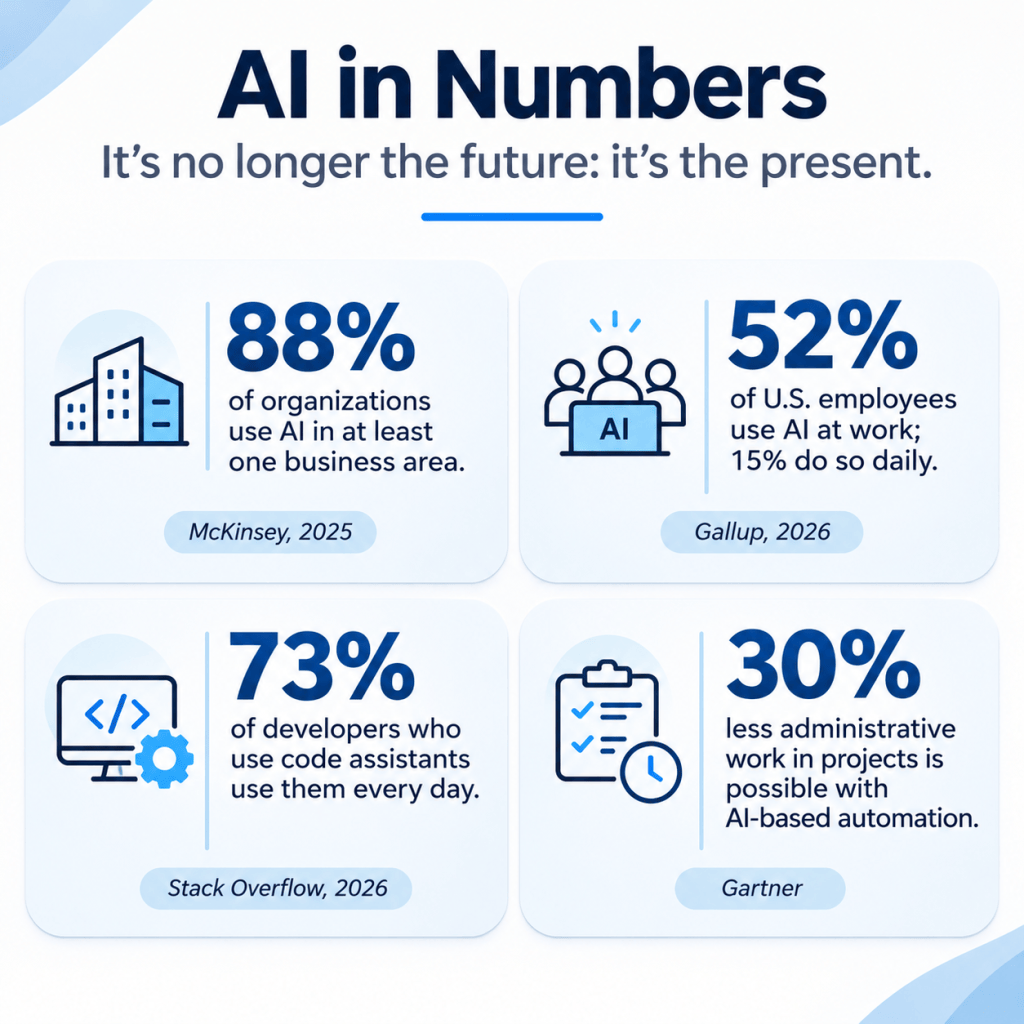
Nearly half trust AI-generated output when they can verify it, and only 24% say their company has approved tools or official guidance. That is where standardization can make a difference.
Stack Overflow Developer Survey 2026, more than 30,000 responses.
Where do we go from here?
To give everyone a common frame of reference, we propose this maturity scale. Most companies are between Levels 2 and 3; our goal is to reach Level 4, steadily and with a structured approach.
Level 1 · Explore Individuals experiment independently, without rules. | Level 2 · Assist AI helps draft and summarize within familiar tools. | Level 3 · Integrate Shared templates and workflows, approved tools, organized data. | Level 4 · Orchestrate (our goal) People and agents work together, with approval checkpoints. |
Our Goal: five principles for using AI responsibly
- AI handles repetitive work; people exercise judgment. We delegate drafts, summaries, and formatting while retaining decision-making.
- A human is always accountable. Everything produced with AI assistance is reviewed and approved by a person.
- Get organized before automating. If information is disorganized, AI will only make the mess faster.
- Approved tools, protected data. Customer and company information must only be entered into authorized tools.
- Learn together and share what works. We share successes, disclose when we use AI, and improve templates as a team.
“AI did not come to replace project managers or administrative teams. It came to raise the standard of our work: less time spent on formatting, more time to make sound decisions.”
The path forward is clear: the technology is already here and will continue to evolve. What will set teams apart is their ability to combine machine speed with human judgment, supported by clear rules and well-organized data.
And you—what level do you think your team is at today?